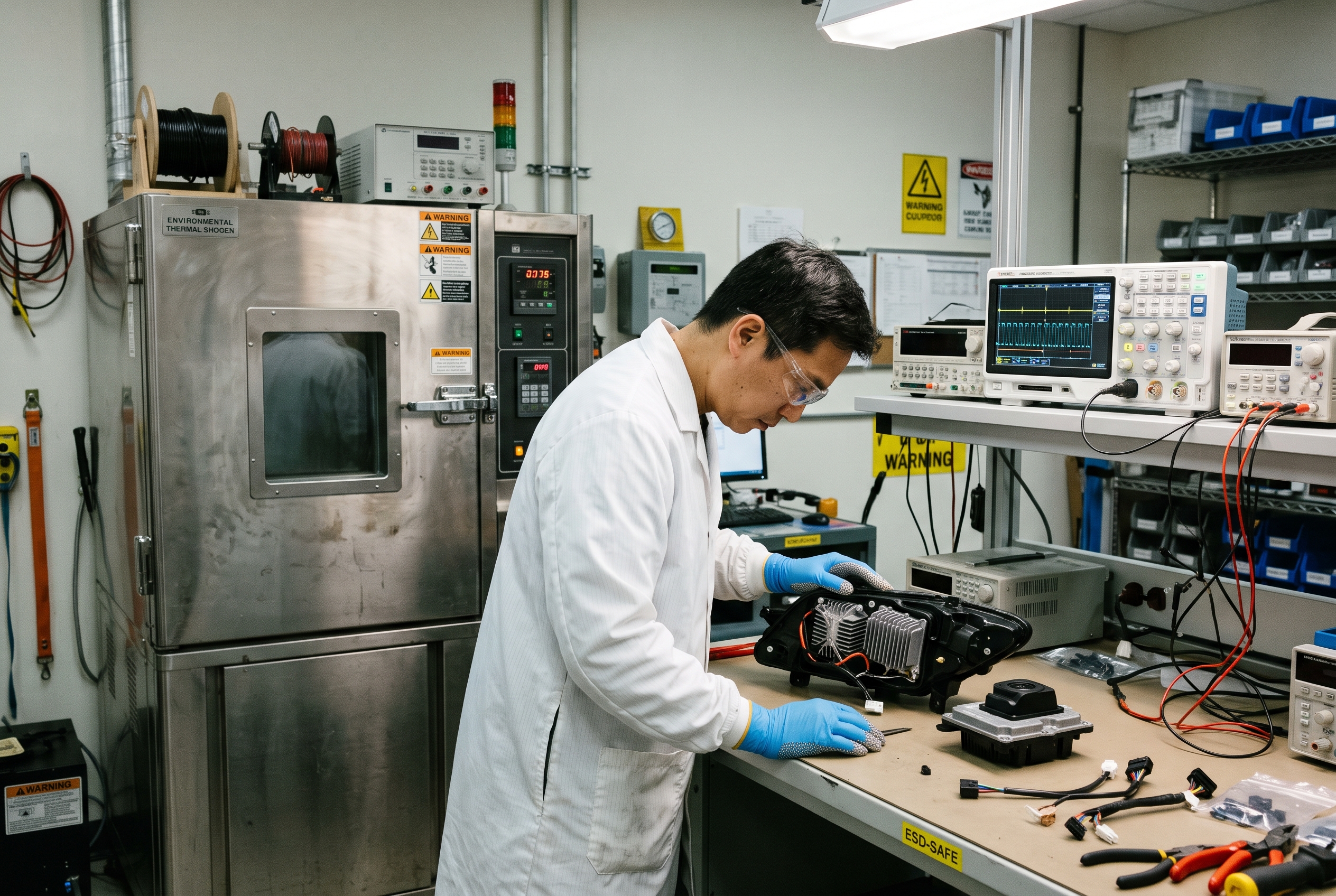
Modern passenger cars and commercial fleets function as sophisticated rolling networks of microprocessors, optical cameras, radar modules, and high output lighting assemblies. Because these electronic systems directly manage collision avoidance, braking stability, and nighttime visibility, even minor environmental degradation can trigger dangerous operational malfunctions. Conducting thorough automotive testing establishes the rigorous laboratory procedures necessary to verify that onboard electronics, protective exterior housings, and wiring assemblies perform reliably under severe moisture, dust, solar radiation, and thermal fluctuations.
Unlike sheltered consumer gadgets, automotive electronics must survive direct exposure to harsh outdoor environments for more than a decade. Subjecting assemblies to accelerated environmental simulations enables engineering teams to uncover subtle sealing weaknesses, optical deterioration, and electrical contact failures before mass manufacturing begins.
Essential Environmental and Reliability Tests for Vehicle Electronics
Confirming the operational stability of vehicle electronics requires targeted laboratory equipment capable of replicating extreme real world driving environments.
- Thermal Shock and Humidity Cycling: Exterior camera modules and underbody control units transition rapidly between icy ambient conditions and intense internal operating heat. Rapid thermal shock chambers accelerate differential expansion between dissimilar plastics and metals, revealing hidden solder joint cracks, housing seal breaches, and internal lens condensation.
- Ingress Protection Against Dust and Water: Exterior radar enclosures, charging port interlocks, and underbody connectors undergo pressurized water jets, immersion tanks, and fine dust chambers under IP67 and IP6K9K protocols to verify housing gasket integrity and breathable vent membranes.
- Electromagnetic Compatibility and Immunity Testing: Dense vehicle wiring harnesses generate radiated and conducted electromagnetic noise that can disrupt wireless communication or sensor signals. Controlled chamber measurements ensure modules neither emit excessive interference nor malfunction when exposed to external radio frequency surges and electrostatic discharge.
- Mechanical Vibration and Shock Endurance: Multi axis electrodynamic shakers replicate rough road profiles, pothole impacts, and engine harmonic frequencies to confirm that heavy capacitors, connectors, and mounting brackets remain mechanically secure without contact fretting.
Automotive Electronics Suppliers Relying on Laboratory Validation
Independent qualification supports engineering sign off and supplier approval across the connected and electrified mobility supply chain.
- Advanced Driver Assistance and Sensor Makers: Developers of automotive radar, lidar, and forward facing vision cameras verify optical clarity, thermal stability, and signal accuracy across severe weather simulations.
- Electric Vehicle Powertrain and Battery Management Producers: Manufacturers of onboard chargers, traction inverters, and battery monitoring boards validate high voltage isolation, thermal dissipation, and transient surge resilience.
- Infotainment, Telematics, and Cockpit Module Suppliers: Producers of digital instrument clusters, touch displays, and wireless connectivity units audit electromagnetic compatibility and electrostatic discharge immunity to prevent screen freezing or audio noise.
- Automotive Lighting and Exterior Actuator Manufacturers: Suppliers of adaptive LED headlamps, active grille shutters, and smart door handles confirm condensation resistance, seal durability, and cyclic mechanical endurance.
Validating electronic durability against extreme weather, electrical surges, and electromagnetic interference prevents costly field recalls and protects vehicle safety systems. By commissioning accredited automotive testing through an Alstesting Laboratory Testing service in Malaysia, tier one electronics suppliers and vehicle manufacturers secure verified reliability data to meet international automotive compliance standards across Southeast Asia.
Frequently Asked Questions (FAQ)
Why is IP6K9K testing important for exterior automotive sensors and cameras?
Exterior vehicle cameras, radar units, and underbody connectors are routinely exposed to high pressure, high temperature washdowns and road spray. IP6K9K testing verifies that enclosure seals, breathable membranes, and cable glands prevent water penetration even under close range, high pressure heated water jets.
How does electromagnetic immunity testing prevent false alerts in driver assistance systems?
Driver assistance sensors process low voltage analog and digital signals while operating near high current motors, power inverters, and wireless transmitters. Electromagnetic immunity testing exposes the module to controlled radio frequency fields and electrical transients to confirm that internal shielding and filtering prevent signal distortion or false braking triggers.
What causes solder joint failure during automotive thermal shock testing?
Printed circuit boards, ceramic capacitors, and metallic component leads expand and contract at different rates when temperatures swing rapidly between freezing and high heat. Repeated thermal expansion mismatches create cyclic shear stress inside solder joints, eventually initiating microcracks that interrupt electrical continuity.