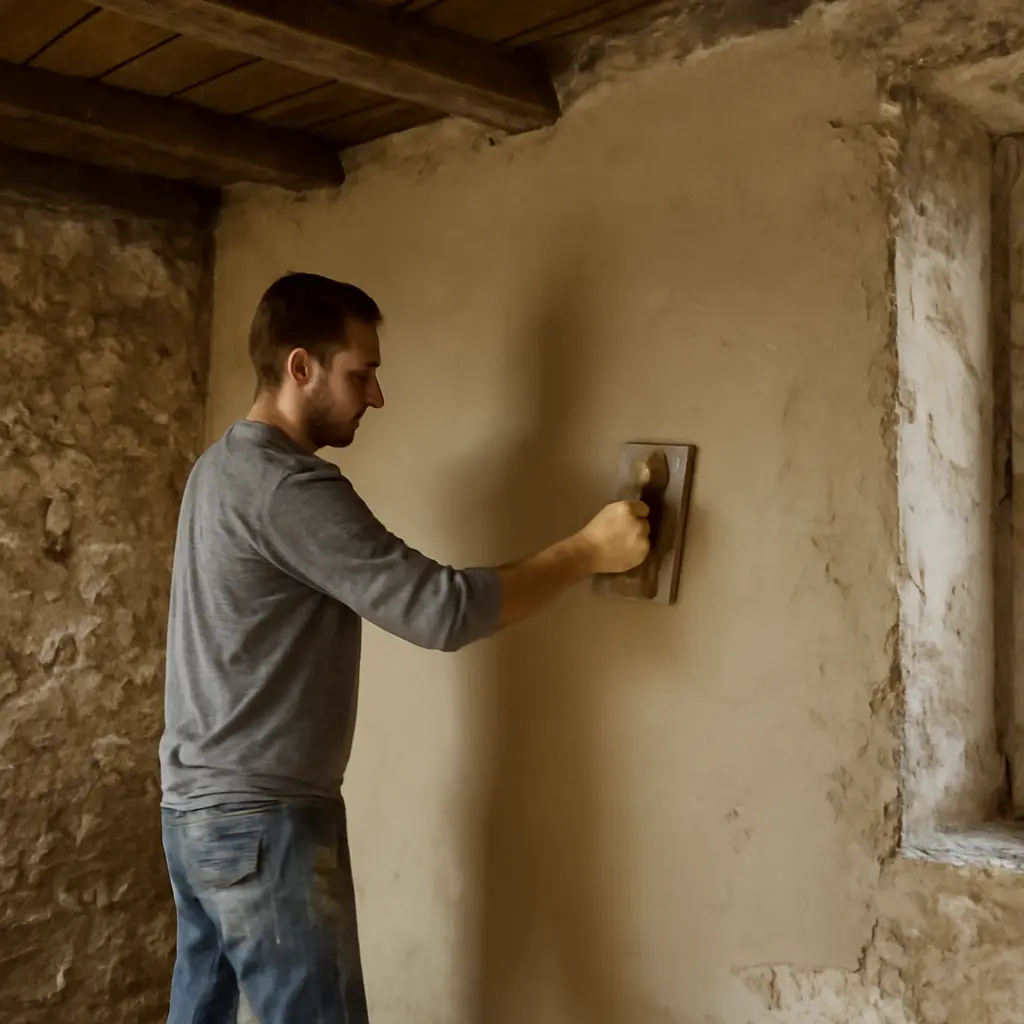
Lime plaster is a breathable, mineral-based wall finish made primarily from lime and aggregate. On damp, salt-damaged, or historically significant walls, it can address problems that impermeable cement render and modern coatings may aggravate: it lets water vapour move through the wall, accommodates some movement, and can be repaired without sealing the masonry behind it. That does not make lime a cure for every defect. The right result depends on diagnosing moisture sources, choosing a compatible plaster system, and allowing it to cure properly. The distinction matters: Historic England notes that traditional solid walls manage moisture differently from modern cavity walls, while the U.S. Environmental Protection Agency advises fixing the source of moisture—not merely treating visible mould.
Why lime plaster can help problem walls
Lime plaster is a wall coating made with lime binder, water, and sand or another suitable aggregate. The Historic England guidance on traditional buildings describes lime as a comparatively flexible, permeable material that can work with older masonry. In practical terms, “breathable” means that water vapour can pass through a material; it does not mean that a wall is waterproof or that liquid water can be ignored.
This compatibility is important because many older walls were built without the damp-proof courses and cavity construction common in newer buildings. Their bricks, stone, mortar, and plaster can absorb and release moisture. A dense, poorly matched coating may slow drying and contribute to damp patches, blistering, or salt damage. Lime plaster can be a more suitable finish when the wall’s construction and moisture conditions call for vapour-permeable materials—but only after leaks, defective drainage, rising ground levels, and other moisture sources have been investigated.
A finish that supports drying
Vapour permeability is the ability of a material to allow water vapour to pass through it. Lime plaster can support drying to the interior when used as part of a compatible wall assembly. This can be useful in solid masonry, where moisture movement through the wall may be part of its normal behaviour. The outcome depends on the plaster’s formulation, thickness, paint or wallpaper finish, and the condition of the masonry; a breathable plaster covered with an impermeable coating may no longer perform as intended.
A finish with some flexibility
Lime plaster can accommodate small amounts of movement better than a rigid, incompatible coating, although it cannot prevent structural movement or bridge every crack. Historic England’s advice on traditional buildings emphasizes using materials that suit the building’s construction. Where cracks are active, wide, or associated with distortion, the underlying cause should be assessed before replastering.
Repairability and material compatibility
Repairability means that damaged areas can be patched using compatible materials instead of requiring a fully sealed, hard coating over the entire wall. Lime-based finishes can be maintained and renewed in stages, which is valuable in historic interiors. Compatibility still matters: the lime type, aggregate, substrate preparation, and finish should be selected for the particular wall rather than chosen by label alone.
Which wall problems lime plaster can address
Lime plaster is most useful when the wall needs a finish that is compatible with traditional masonry and can dry through its surface. It may improve the performance of a wall that has been trapped behind dense coatings, but it cannot substitute for building repairs. The National Park Service’s preservation guidance similarly treats traditional plaster as part of a building system: materials and repair methods should respond to the substrate and the source of deterioration.
Dampness behind dense coatings
A damp wall is a symptom, not a diagnosis. Water may enter through roof or plumbing leaks, defective pointing, blocked gutters, high exterior ground levels, or condensation. If a dense coating is restricting drying, replacing it with a suitable lime system may help the wall release moisture. But replastering alone will not stop continuing water entry. The EPA’s mould guidance stresses correcting the moisture problem as the essential step in preventing recurring mould growth; that principle also applies to damp-wall repairs.
Salt contamination and crumbling plaster
Soluble salts can move with moisture and crystallize as a wall dries, damaging plaster and masonry. Lime plaster is sometimes chosen in salt-affected areas because it is compatible with traditional materials and can be renewed if sacrificial surface layers deteriorate. “Sacrificial” does not mean that salts disappear: the source of moisture and salt movement must be addressed, and heavily contaminated material may need careful removal or specialist treatment. Salt identification and the choice of replacement plaster should be based on a site assessment.
Cracks and uneven historic masonry
Older walls are rarely perfectly flat, and some contain small, long-standing cracks or irregular surfaces. Lime plaster can be applied in suitable coats to accommodate the character of the substrate and create a repairable finish. It is not a structural repair: cracks that continue to widen, recur rapidly, or accompany bulging masonry require investigation by a qualified building professional before cosmetic work begins.
Historic buildings and conservation work
In historic buildings, retaining original fabric and matching its material behaviour are central considerations. Lime plaster may be appropriate where original lime work survives or where the wall is built from traditional solid masonry. Conservation guidance recommends assessing the building as a whole; a modern cement-based repair may be unsuitable in some settings, but lime is not automatically correct for every historic wall. Local conservation requirements and the existing construction should guide the specification.
Choosing and applying a lime plaster system
“Lime plaster” covers different binders and mixes, so specifying it requires more than asking for a lime finish. The type of lime, aggregate grading, coat sequence, substrate, exposure, and final decoration all affect performance. A competent plasterer or conservation professional should identify the wall construction and moisture conditions before recommending a system.
Air lime and hydraulic lime
Air lime hardens mainly by reacting with carbon dioxide in the air, while natural hydraulic lime also sets through reactions with water. These are different materials with different setting and exposure characteristics. The appropriate choice depends on the wall, location, and curing conditions; a harder or faster-setting mix is not automatically better. Product data and specialist advice are important, particularly for exposed or unusually damp locations.
Preparation and curing
Preparation includes removing loose or incompatible finishes where appropriate, repairing the substrate with compatible materials, and managing background suction. Lime plaster generally needs protection from rapid drying, frost, and unsuitable site conditions while it cures. Exact requirements vary by product and season, so follow the manufacturer’s instructions and the plasterer’s specification. Rushing the work or applying an incompatible paint can undermine an otherwise suitable repair.
Decoration and ongoing maintenance
The final coating is part of the wall system. Vapour-permeable finishes, such as suitable limewash or compatible mineral paints, are commonly considered for lime plaster. A film-forming paint or vinyl wallpaper may restrict drying, depending on the product and assembly. Before decorating, confirm that the plaster has cured sufficiently and that the chosen finish is compatible; retain product information for future maintenance and repairs.
What lime plaster cannot fix
Lime plaster is a finish and a compatible component of a wall assembly, not a universal damp-proofing treatment. It cannot repair a leaking pipe, stop rain entering through failed pointing, correct poor drainage, or stabilize a moving structure. The Building Research Establishment and government building guidance both emphasize understanding moisture in context rather than relying on a single surface symptom or a one-size-fits-all treatment.
- A persistent leak needs plumbing or roof repairs before replastering.
- Condensation requires attention to ventilation, heating, insulation, and moisture production.
- Water entering through external walls may require repairs to pointing, rainwater goods, or exposed details.
- Structural cracks, bulging, or displacement need assessment before cosmetic covering.
- Salt damage may recur if moisture and salt sources remain active.
A simple moisture survey should therefore begin with observations: where dampness appears, whether it changes with weather or household use, the condition of external surfaces, and any history of leaks or alterations. Handheld moisture meters can be useful screening tools, but readings in masonry can be affected by salts and material composition. They should not be treated as a diagnosis on their own.
Conclusion: lime plaster as a compatible repair, not a shortcut
Lime plaster can transform a problem wall when the underlying issue involves an incompatible, overly dense finish on traditional masonry: its vapour permeability, relative flexibility, and repairability may help the wall function more appropriately. It is particularly relevant to damp-affected solid walls, salt-damaged plaster, uneven historic masonry, and conservation work. But those advantages depend on correct diagnosis, a suitable lime system, careful curing, and compatible decoration.
Before replacing a failed finish, identify and fix the moisture source, check for structural movement, and consult a practitioner experienced with the building type. For further reading, review Historic England’s guidance on traditional buildings, the National Park Service’s preservation briefs on historic plaster, and the EPA’s moisture and mould guidance. The most durable repair is not simply a different plaster; it is a wall system that can manage moisture without concealing the cause.
Sources: Historic England, Energy Efficiency and Historic Buildings: Insulating Solid Walls, https://historicengland.org.uk/images-books/publications/eehb-insulating-solid-walls/; Historic England, Practical Building Conservation: Building Environment, https://historicengland.org.uk/advice/technical-advice/buildings/building-environment/; National Park Service, Preservation Brief 21: Repairing Historic Flat Plaster—Walls and Ceilings, https://www.nps.gov/orgs/1739/upload/preservation-brief-21-flat-plaster.pdf; U.S. Environmental Protection Agency, A Brief Guide to Mold, Moisture and Your Home, https://www.epa.gov/mold/brief-guide-mold-moisture-and-your-home; SPAB, The Society for the Protection of Ancient Buildings, Damp, https://www.spab.org.uk/advice/damp