Post-occupancy evaluation (POE) is the systematic assessment of a building after people begin using it. It compares what a design intended to achieve with what occupants actually experience, using feedback, observation, and building-performance data to identify successes and problems. POE matters because buildings can miss their goals for comfort, usability, energy use, or accessibility even when they meet design specifications. The U.S. General Services Administration (GSA) describes POE as a way to assess building performance and inform future projects; its studies of federal buildings have used occupant surveys to examine satisfaction with environmental conditions. This article explains POE’s definition and methods, the outcomes it can evaluate, how findings can lead to design changes, and what real-world evidence shows about closing the loop.
Post-Occupancy Evaluation: Definition and Core Attributes
Architect Wolfgang F. E. Preiser, an influential POE researcher, defines post-occupancy evaluation as the process of evaluating buildings systematically and rigorously after they have been built and occupied. The central attribute is comparison: evaluators examine actual building performance against user needs, project objectives, relevant standards, and the design team’s stated intentions. Unlike a final construction inspection, which checks whether a building was delivered according to contract documents, POE asks whether it works well for the people who use it.
POE is not one standardized test. It can range from a rapid walkthrough to a detailed, multi-season research study. Its most useful forms combine multiple kinds of evidence: occupant accounts, direct observation, facilities records, and measurements such as temperature, lighting, or energy use. The GSA’s Building Performance Evaluation program, for example, has used occupant surveys alongside building-performance information to understand how federal workplaces function in practice. Combining evidence helps distinguish a one-off complaint from a recurring design or operations issue.
POE as a process of learning and comparison
A POE evaluates a building in use, then interprets the gap—or alignment—between intended and observed outcomes. That requires a clear account of the original goals. If a project promised flexible work settings, for example, the evaluation should assess whether people can use those settings effectively, rather than treating the mere presence of varied furniture as proof of success. Researchers can organize evaluation around three broad levels: indicative evaluations, which identify apparent strengths and weaknesses; investigative evaluations, which examine specific issues in greater depth; and diagnostic evaluations, which test causes and relationships using more extensive evidence.
Stakeholders, timing, and scope
The people who occupy, operate, maintain, and manage a building may experience different aspects of its performance. A useful POE therefore considers groups such as regular occupants, visitors, facilities staff, and building owners. Timing also matters: an early review can catch usability problems while adjustments are still practical, while a later review can reveal seasonal patterns or longer-term operational issues. The chosen scope should match the question—for example, a focused review of glare in work areas or a whole-building assessment of comfort, access, and energy performance.
POE Methods: Evidence for Testing Design Intent
Because no single method captures every aspect of building performance, POE commonly combines qualitative and quantitative approaches. The research question determines which methods are appropriate, how many people or spaces to include, and what comparison is meaningful. The following methods are complementary: surveys can show how widespread an experience is, while interviews and measurements can help explain why it occurs.
Occupant surveys and interviews
Occupant surveys collect structured reports on matters such as thermal comfort, acoustics, lighting, privacy, and satisfaction. Interviews and focus groups add detail about routines, workarounds, and unmet needs that fixed-response questions may miss. The Center for the Built Environment at the University of California, Berkeley, developed a widely used indoor-environment survey that asks occupants about environmental conditions and their satisfaction. Survey results are most informative when responses are reported by relevant groups or locations, rather than collapsed into a single building-wide average that can conceal uneven experiences.
Walkthroughs and behavioral observation
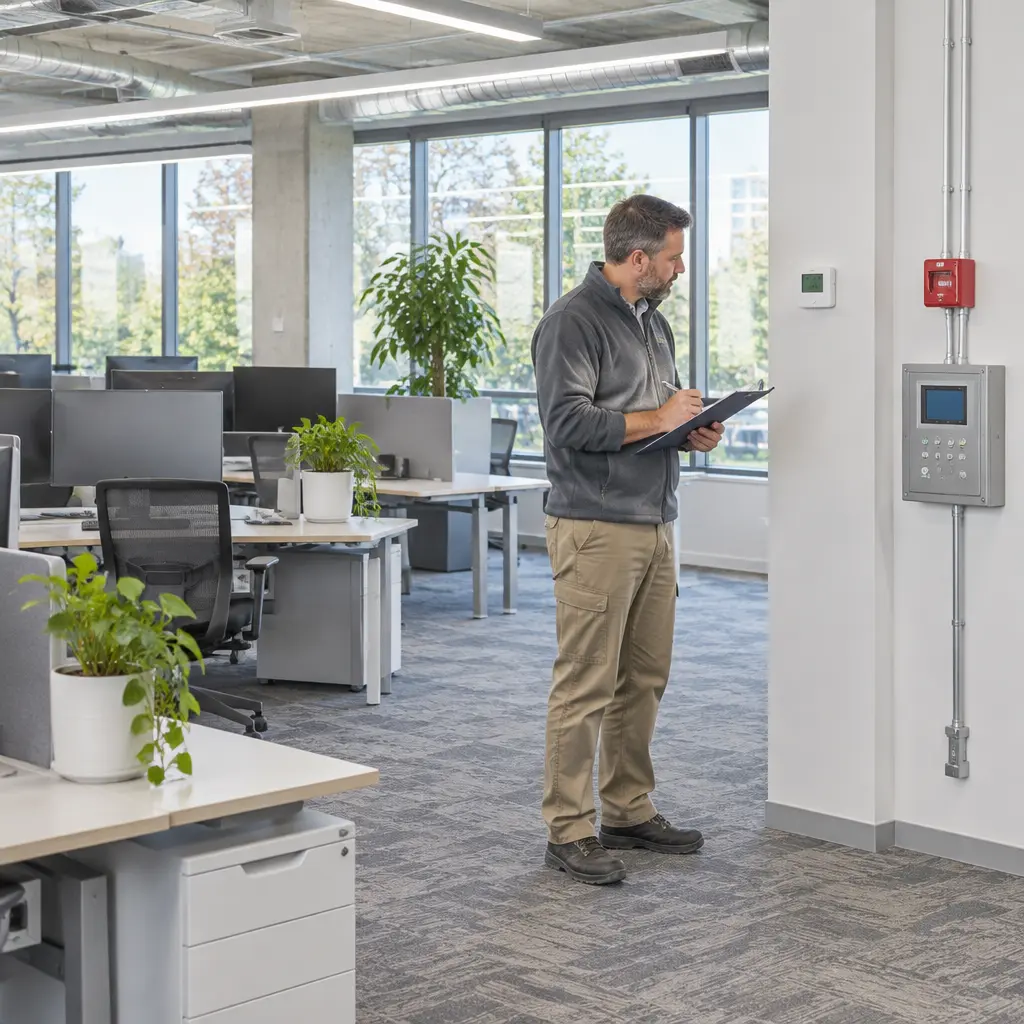
A walkthrough is a structured inspection of spaces and how they function in everyday use. Evaluators may record circulation obstacles, confusing wayfinding, unused rooms, informal work areas, or recurring adjustments such as occupants closing blinds to manage glare. Observation can reveal discrepancies between planned use and actual behavior, but it should not be treated as a substitute for asking occupants why they behave that way. Pairing observation with interviews makes interpretations more reliable.
Environmental measurements and building records
Measurements can test whether conditions match performance targets. Depending on the project, these may include temperature, relative humidity, carbon dioxide as an indicator of ventilation conditions, illuminance, sound levels, energy consumption, or water use. Facilities work orders, controls-system data, and maintenance logs can show whether complaints correspond with recurring equipment problems or operating schedules. Researchers should interpret measurements in context: a sensor reading at one location or moment cannot establish the experience of every occupant throughout the year.
POE Outcomes: What Buildings Are Evaluated For
Once evidence has been gathered, evaluators organize findings around the outcomes the project was meant to achieve. These categories overlap: a ventilation problem can affect comfort and health, while an accessibility issue can also signal a failure of wayfinding or operational planning. Explicit criteria help make findings useful for decision-makers rather than leaving them as a list of unrelated observations.
Comfort, indoor environmental quality, and health
Indoor environmental quality covers conditions such as thermal comfort, air quality, lighting, and acoustics. POE can identify areas where occupants report persistent discomfort, then test possible contributing factors using measurements and building records. The World Health Organization’s 2021 global air-quality guidelines set recommendations for several outdoor pollutants; they are not a building-specific POE standard, but they underline why air quality is an important public-health concern. Indoor findings should be interpreted using applicable regulations and technical guidance, not by treating a single measurement as proof of a health outcome.
Usability, accessibility, and inclusion
Usability concerns whether spaces, controls, and services support the activities people need to perform. Accessibility examines whether people with different abilities can enter, navigate, understand, and use the building. An evaluation might review routes, entrances, signage, controls, restrooms, and the practical usability of shared spaces, while consulting people with varied access needs. The U.S. Access Board’s accessibility standards provide technical requirements for covered facilities, but a POE can also reveal practical barriers that a checklist alone may not surface, such as confusing routes or controls that are difficult to operate.
Energy, operations, and maintenance
Operational performance includes how reliably building systems function and how much energy or water they use in practice. Evaluators can compare utility data and control-system trends with the project’s targets, while checking whether operating schedules and maintenance practices support those targets. The U.S. Department of Energy’s Better Buildings resources emphasize the role of measuring building energy performance in managing improvements. A low energy-use figure alone does not prove success: it must be interpreted alongside occupancy, weather, operating hours, comfort, and the project’s stated objectives.
Closing the Loop: Turning Findings into Design and Operational Change
An evaluation closes the loop only when its findings inform action. Reporting problems without assigning responsibility, resources, or follow-up leaves the gap between design intent and lived experience unresolved. A practical response translates evidence into changes to the building, its controls, its operating procedures, or the brief for future projects, then checks whether those changes worked.
From findings to prioritized actions
A clear POE report links each finding to evidence, its likely causes, the groups or spaces affected, and a recommended next step. Teams can prioritize actions by severity, frequency, number of people affected, cost, and feasibility. For instance, a recurring glare complaint supported by observations and daylight readings might lead to changes in shading controls or workstation layout. By contrast, an isolated comment may warrant further investigation before a costly intervention is made.
Feedback to design teams and future projects
POE findings become especially valuable when they are fed into later briefs, standards, and design reviews. A project team can record which assumptions held up, which details required adjustment, and what maintenance or user guidance was needed. The GSA’s evaluation work illustrates this organizational-learning purpose: post-occupancy evidence can help owners and project teams understand performance beyond delivery and use lessons to inform future facilities. To preserve that value, findings should be shared in a format that designers, operators, and decision-makers can act on.
Follow-up and verification
After an intervention, a follow-up check tests whether conditions improved and whether the change introduced new problems. The check may repeat a short survey, review work-order patterns, or compare measurements before and after a control adjustment. Where practical, teams should document the baseline, timing, and relevant changes in occupancy or weather. This makes it easier to distinguish the effect of an intervention from unrelated changes and turns POE into an ongoing management practice rather than a one-time report.
POE in Practice: Evidence, Examples, and Limitations
Real-world examples show why occupants’ experiences and technical data need to be considered together. They also show that POE evidence has limits: findings from one building or user group should not automatically be generalized to every project. The strongest use of case studies is to identify testable questions and transferable lessons, not to assume that one design solution will work everywhere.
Federal workplace evaluations
The U.S. General Services Administration has conducted post-occupancy and building-performance evaluations in federal workplaces, examining occupant satisfaction and aspects of building operation. This approach reflects a practical principle: a building’s performance is not fully described by its design drawings or equipment specifications. Surveys can reveal patterns in occupant experience, while operational information helps teams investigate whether those patterns relate to controls, space planning, or building systems. The value lies in connecting findings to decisions about current facilities and future projects.
The Center for the Built Environment’s occupant survey
The Center for the Built Environment at UC Berkeley provides a structured survey approach for assessing indoor environmental quality in buildings. Its framework helps organizations collect comparable occupant feedback across environmental categories, making it easier to locate patterns that a small number of informal comments might miss. The survey is a measurement tool, not a diagnosis on its own: building teams need to interpret responses alongside the building’s layout, systems, operating practices, and measured conditions.
Common limitations and safeguards
POE results can be affected by low survey participation, recall bias, seasonal variation, changing occupancy, and differences in how people interpret questions. Averages may hide problems concentrated in particular rooms or groups. To improve confidence, evaluators should explain the purpose of the study, protect respondents’ privacy, report response rates and limitations, and use more than one evidence source where appropriate. They should also avoid claiming that an association—such as a link between an environmental condition and satisfaction—proves causation without a suitable study design.
Conclusion: Make Post-Occupancy Evaluation Part of the Building Lifecycle
Post-occupancy evaluation is a structured way to compare design intent with actual building use. Its methods—surveys, interviews, observation, environmental measurements, and operational records—help assess comfort, indoor environmental quality, accessibility, usability, energy, and maintenance. The process delivers its greatest value when findings lead to prioritized actions, inform future design decisions, and are checked again after changes are made.
For building owners and project teams, a practical next step is to define measurable performance goals before occupancy, plan a review with occupants and facilities staff, and assign responsibility for acting on results. Treating POE as a continuing feedback loop can make buildings more responsive to the people who use them and help future projects learn from the realities of everyday operation.
Sources: Preiser, Wolfgang F. E., “The Evolution of Post-Occupancy Evaluation: Toward Building Performance and Universal Design Evaluation,” Learning from Our Buildings: A State-of-the-Practice Summary of Post-Occupancy Evaluation, National Academies Press, 2001, https://nap.nationalacademies.org/catalog/10288/learning-from-our-buildings-a-state-of-the-practice-summary-of-post-occupancy-evaluation; U.S. General Services Administration, “Building Performance,” https://www.gsa.gov/real-estate/design-and-construction/design-excellence/building-performance; Center for the Built Environment, University of California, Berkeley, “Occupant Indoor Environmental Quality Survey,” https://cbe.berkeley.edu/research/occupant-survey/; World Health Organization, WHO Global Air Quality Guidelines, 2021, https://www.who.int/publications/i/item/9789240034228; U.S. Access Board, “About the ADA Standards,” https://www.access-board.gov/ada/; U.S. Department of Energy, Better Buildings, “Building Energy Data,” https://betterbuildingssolutioncenter.energy.gov/